
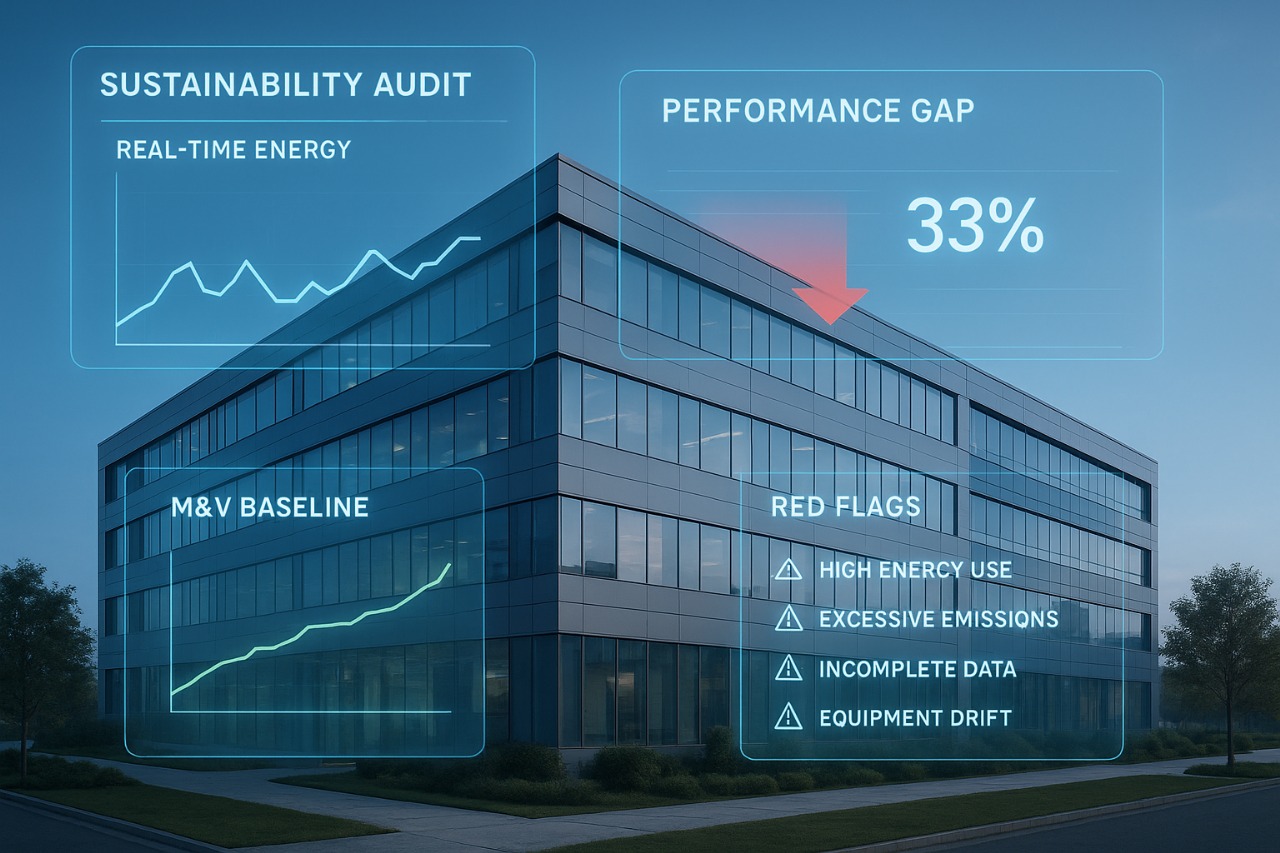
Corporate sustainability reports increasingly trumpet building-level achievements — energy reductions, “green” certifications, net-zero pledges. Yet independent verification and post-occupancy measurement routinely reveal a different picture: many certified or claimed gains don’t hold up in operation. This article explains why corporate buildings fail third-party infrastructure verification, how greenwashing and audit design contribute, and which practical fixes close the gap.
The performance gap: models vs. lived operation
A core cause of failed verification is the energy (and performance) gap — the difference between modeled or expected performance at design/commissioning and measured performance during occupation. Models assume idealized occupancy, perfect controls, and stable operations; reality delivers behavioral variability, maintenance drift, and equipment degradation. Empirical studies show the performance gap persists across building types and regions, and it directly undermines audit outcomes when auditors compare modelled baselines to observed consumption.
Greenwashing, weak verification scopes, and conflicted incentives
Not all failures are technical. Audit scope and auditor incentives matter. When verification focuses on paperwork (design features, installed technologies, or one-time commissioning reports) rather than ongoing measured performance, certifications can be earned without sustained outcomes — the classic greenwashing pathway. Systematic reviews of sustainability assurance note the field’s uneven standards, variable assurance practices, and the risk that audit frameworks emphasize disclosure over independent validation. Auditors contracted by clients or certification bodies with commercial relationships can also create conflicts that weaken rigor.
Measurement & Verification (M&V) failures: baselines, data quality, and methodology
Third-party verification hinges on robust M&V: good baselines, quality meter data, and defensible statistical adjustment for weather and occupancy. Common pitfalls are (a) poor baseline selection, (b) insufficient or noisy consumption data, (c) lack of sub-metering for major end-uses, and (d) inappropriate adjustment models. MDPI case studies stress that an accurate Energy Baseline (EnBL) and ongoing M&V are essential — otherwise “compliance” is just paperwork.
Operational and organizational gaps: O&M, occupant behavior, and data governance
Even when technical systems are well designed, operations and maintenance (O&M) practices determine long-term outcomes. Lack of formal O&M procedures, vendor handover failures, and poor fault follow-up lead to drift from design intent. Occupant behaviour (setpoints, plug load habits) also drives discrepancies. Research on campus and building sustainability tools shows that assessment frameworks frequently underweight operational governance and occupant effects — both of which auditors must check but often do not in depth. Strengthening data governance (continuous metering, data retention, and anomaly detection) is therefore central to narrowing the audit gap.
Actionable fixes: how to close the verification gap (practical roadmap)
Closing the audit gap requires a program that blends better measurement with governance and transparency. Recommended, evidence-backed steps:
- Adopt continuous M&V — deploy sub-metering and time-series meters for critical end-uses; use weather-normalized and occupancy-aware baselines.
- Shift audits from snapshot to performance windows — require auditors to evaluate multi-month (or year) operational data, not just single-point commissioning reports. (Performance gap literature supports longer windows for robust assessment.)
- Strengthen governance and conflict-of-interest rules — require independent third parties with no commercial ties to certification outcomes; mandate public disclosure of audit scope and methods (as suggested by sustainability assurance reviews).
- Operationalize occupant and O&M controls — include occupant engagement programs, automated fault detection, and documented O&M SLAs that auditors can verify.
- Use digital twins and continuous analytics for verification — digital twins tied to live meters to create auditable, timestamped evidence of system performance and interventions, simplifying third-party verification.
Conclusion — from badge to behavior: restoring trust in building sustainability
Third-party verification is only as good as the data, methods, and governance behind it. To move beyond badges and press releases, organizations must treat sustainability verification as an ongoing operational discipline — continuous measurement, transparent baselines, robust governance, and independent audits that privilege measured outcomes over product lists. The academic and applied literature is clear: closing the sustainability audit gap is less about more certifications and more about better measurement, stronger governance, and operational follow-through. (For comprehensive reviews and methods cited above, see the MDPI and NCBI resources linked in each section).
References
- https://www.mdpi.com/2071-1050/11/3/937
- https://pmc.ncbi.nlm.nih.gov/articles/PMC8596354/
- https://www.mdpi.com/2076-3417/14/20/9403
- https://pmc.ncbi.nlm.nih.gov/articles/PMC9747594/
- https://www.mdpi.com/2076-3417/14/20/9403
- https://www.mdpi.com/2071-1050/11/3/937
- https://pmc.ncbi.nlm.nih.gov/articles/PMC8596354/
- https://www.mdpi.com/2071-1050/11/3/937
- https://www.mdpi.com/2076-3417/14/20/9403


