
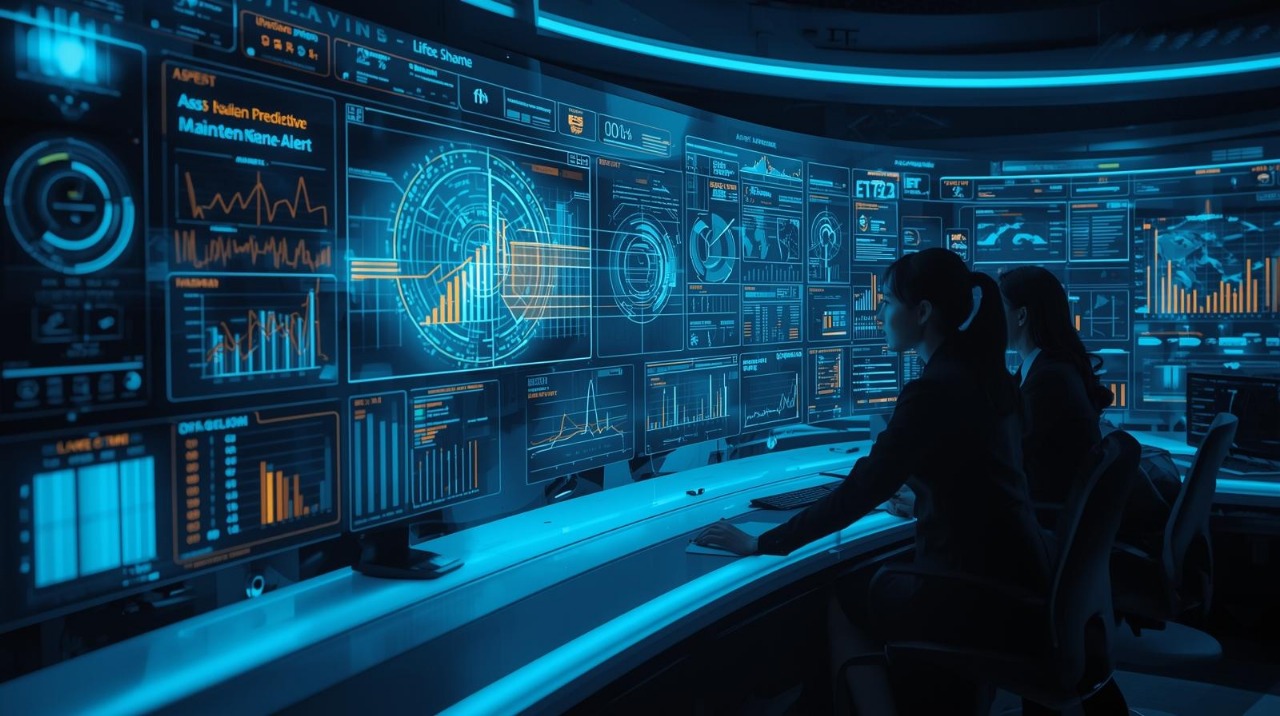
In today’s complex infrastructure environments, companies are increasingly using artificial intelligence (AI) and machine learning (ML) to span the full lifecycle of their assets — from initial commissioning, through optimized operation, to eventual decommissioning. This lifecycle-wide approach enables enterprises to extract maximum value, reduce risk, and proactively retire or repurpose infrastructure at the end of its useful life.
Why a lifecycle approach matters
Assets—whether HVAC units, surveillance systems, or building structural components—go through multiple phases: design and commissioning, ongoing operation and maintenance, and ultimately retirement or decommissioning. Traditional approaches often treat these phases in silos, leading to inefficiencies, unforeseen failures, and higher cost of ownership. By adopting a holistic lifecycle mindset, companies can apply AI/ML models to anticipate performance issues, schedule optimal maintenance, and plan decommissioning or reuse before asset failures escalate. A systematic review of AI applications in building lifecycles finds that AI is increasingly deployed across commissioning, operation, and decommissioning phases.
Commissioning: Predicting performance from Day One
When assets are first installed and commissioned, initial performance predictions set the baseline for future reliability and cost. AI-based digital twins and sensor networks capture real-time commissioning data—such as temperature drift in HVAC systems, vibration signatures, or power usage in a new installation—and compare them against expected models. For example, an MDPI article on “A Model for Predictive Maintenance Based on Asset Administration Shell” describes how ML techniques can be embedded into asset models to improve lifecycle traceability and condition prediction.
By predicting early deviations and anomalies, organizations can intervene proactively, reducing costly retrofits and improving operational stability before full deployment.
Operation and Optimization: AI drives smarter maintenance and usage
Once assets are live, the greatest value often comes from optimizing their operation and lifecycle cost. AI/ML models ingest sensor data, identify usage patterns, predict remaining useful life (RUL), and recommend maintenance just in time. A review titled “Review of synergy between machine learning and first principles models for asset integrity management” demonstrates how ML and physics-based models jointly help extend asset life and improve reliability.
In smart-building contexts, a study found that AI and deep-learning controllers produced median energy savings of 18–35% through operational optimization.
This operational phase also includes monitoring for obsolescence and planning upgrades or repurposing, allowing asset managers to move from reactive maintenance to predictive and prescriptive asset strategies.
Decommissioning and End-of-Life Planning: AI completes the cycle
The final phase of the asset lifecycle — decommissioning or reuse — is often overlooked. Effective end-of-life planning includes safe disposal, recycling of materials, or adaptive reuse of infrastructure components. In “AI-Driven Digital Twins in Industrialised Offsite Construction: A Systematic Review,” the authors emphasize the need for lifecycle systems-thinking that spans all phases including decommissioning.
By leveraging AI and digital twin models, infrastructure owners can estimate remaining value, schedule retirement proactively, and avoid last-minute scrap or failure costs. This contributes to circular economy goals and reduces environmental and financial liabilities.
The strategic value for enterprises
AI-powered asset lifecycle management transforms asset ownership from capital-intensive and static to intelligent, performance-driven and future-proof. For corporate campuses, infrastructure portfolios, and industrial sites, this means fewer unplanned outages, optimized maintenance spends, extended asset life, and smarter infrastructure renewal decisions. As the literature underscores, integrating AI across commissioning, operation and decommissioning is not just a technical upgrade—it is a strategic differentiator.
In this era of digital infrastructure, treating assets as managed lifecycles rather than one-time purchases will differentiate leading enterprises.
References
- https://www.mdpi.com/2075-5309/14/7/2137
- https://www.mdpi.com/1424-8220/20/21/6028
- https://www.frontiersin.org/journals/chemical-engineering/articles/10.3389/fceng.2023.1138283/full
- https://www.mdpi.com/2075-5309/15/15/2631
- https://www.mdpi.com/2075-5309/15/17/2997
- https://www.mdpi.com/2075-5309/14/7/2137


