
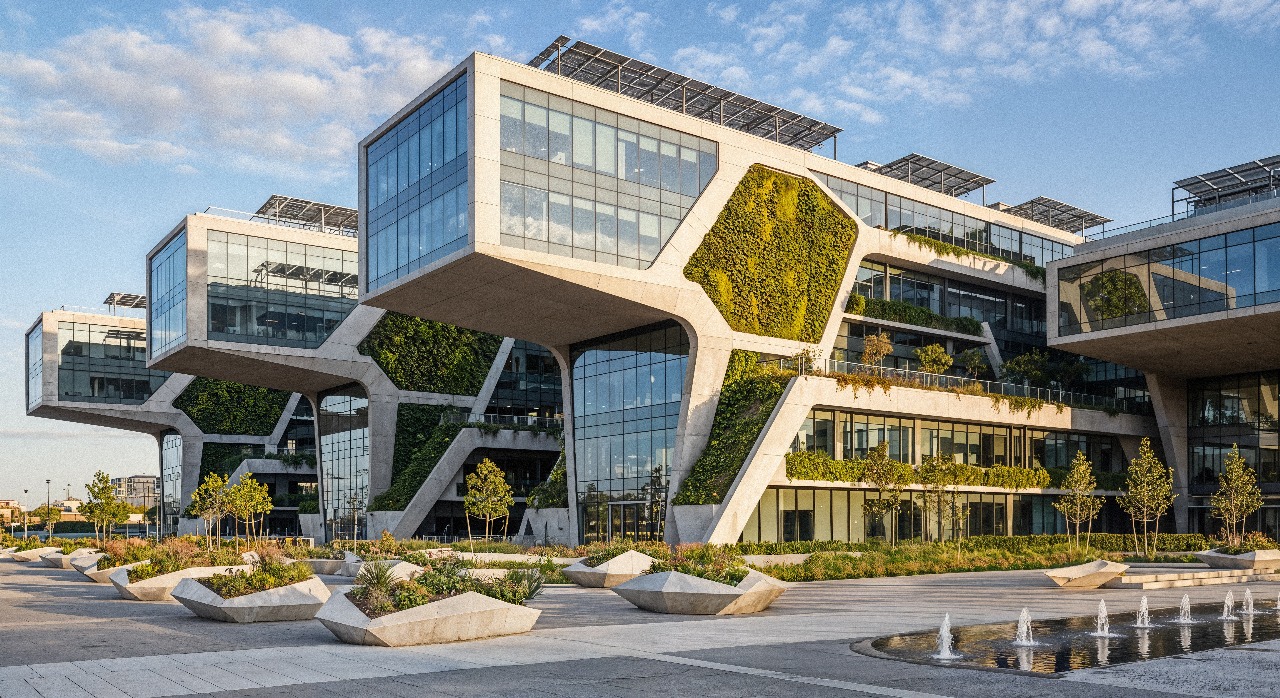
Sustainability expectations from investors, regulators, and stakeholders are compelling Fortune 500 enterprises to rethink facility design—and align real estate strategy with ESG mandates. Green infrastructure—whether via retrofits or new builds hitting LEED/BREEAM certification—serves as a measurable lever to reduce carbon emissions, enhance occupant well‑being, and demonstrate long‑term strategic value (ESG).
ESG Reporting, Green R&D & Strategic Investment
A PubMed-indexed study of Chinese A‑share firms shows that ESG reporting significantly strengthens the impact of green R&D spend on corporate green innovation—i.e., companies that publicly report ESG metrics achieve greater returns on “green patents” and environmentally beneficial innovation. For Fortune 500 firms, facility investment in sustainable materials, energy systems, and certification signals to investors that ESG is deeply embedded in infrastructure planning.
Retrofitting & Certification Strategies
Many Fortune 500 firms are choosing retrofit over rebuild, yielding far lower embodied carbon—savings of 50–75% are typical when repurposing versus new construction. Retrofitting older facilities with HVAC upgrades, renewable energy systems, LEED or BREEAM certification, and biophilic design upgrades also improves ESG scores and occupant productivity.
Green Finance & Cost‑Benefit Outcomes
The growth of green finance (e.g. green bonds) is enabling sustainable infrastructure investment by aligning returns with ESG impact. Academic reviews show that green buildings deliver improved lifecycle economics: lower energy costs, enhanced asset value, and access to sustainability-linked financing. Investors increasingly reward sustainable property portfolios, recognizing that ESG excellence drives lower capital costs and public trust.
ESG Performance & Smart City Integration
Enterprise facilities remain an anchor for ESG performance—smart city pilots in China improved ESG scores of manufacturing firms by 15.9% on average, via infrastructure investments, internal controls, and green innovation—demonstrating infrastructure’s direct link to ESG outcomes. While not limited to smart cities, Fortune 500 multi-site campuses are adopting similar smart design principles for scalable ESG impact.
The Business Case: ESG Value Creation and Investor Alignment
Strong ESG performers generate sustainable investor confidence and long-term cash flow advantages. Research finds that ESG excellence reduces the weighted average cost of capital, increases ROIC, and enhances market valuation—especially in firms with mature disclosure practices. Green infrastructure projects provide visible, measurable ESG credentials that investors can audit, strengthening reputational capital and resilience.
Emerging Challenges & Strategic Considerations
- Certification vs. Performance Gap: Certification systems like LEED and BREEAM set design standards, but actual building performance can fall short if occupant environmental quality metrics (temperature, air quality, acoustics) are not met post-occupancy.
- Material and supply-chain sustainability: ESG‑aligned sourcing of low-carbon materials is complex—scope 3 emissions from embodied carbon remain hard to measure reliably.
- Integration & stakeholder alignment: Sustainability strategy requires coordination across real estate, procurement, operations, sustainability and investor relations functions to create unified infrastructure initiatives.
- Access to green capital and financing: Green bonds and ESG-labeled funding remain growing but require transparency and alignment with recognized financial frameworks.
Conclusion
Fortune 500 companies are increasingly meeting ESG imperatives through thoughtful facility design—spanning new construction and retrofits powered by green materials,
renewable energy, biophilic design, and smart infrastructure metrics. These investments reduce carbon footprints, elevate occupant well‑being, and support sustainable financing while enhancing investor confidence and long‑term value.
Enterprise infrastructure leaders should pursue phased retrofit strategies, secure LEED/BREEAM certification, integrate green finance mechanisms, and align facilities with measurable ESG reporting frameworks. By doing so, these firms can unlock substantial environmental, social, and governance impact—while positioning infrastructure as a strategic enabler for long‑term corporate resilience and market leadership.
References
- Fang & Guo (2025). ESG performance and firm value from PubMed/PMC study of Chinese firms, showing strategic benefit from ESG reporting and R&D about green innovation https://pubmed.ncbi.nlm.nih.gov/40267140/
- https://pubmed.ncbi.nlm.nih.gov/38547119/
- CannonDesign net‑zero retrofit study saving embodied carbon by 50–75% (Time news) https://time.com/7177539/cannondesign-net-zero-emissions-buildings/
- Systematic review: Green finance and green buildings economics https://www.sciencedirect.com/science/article/abs/pii/S0959652622014792
- https://www.frontiersin.org/journals/environmental-science/articles/10.3389/fenvs.2023.1305539/full
- https://pubmed.ncbi.nlm.nih.gov/40267140/
- http://emerald.com/ijbpa/article/41/1/1/112245/Guest-editorial-Building-performance-and
- https://www.gihub.org/articles/esg-in-infrastructure


