
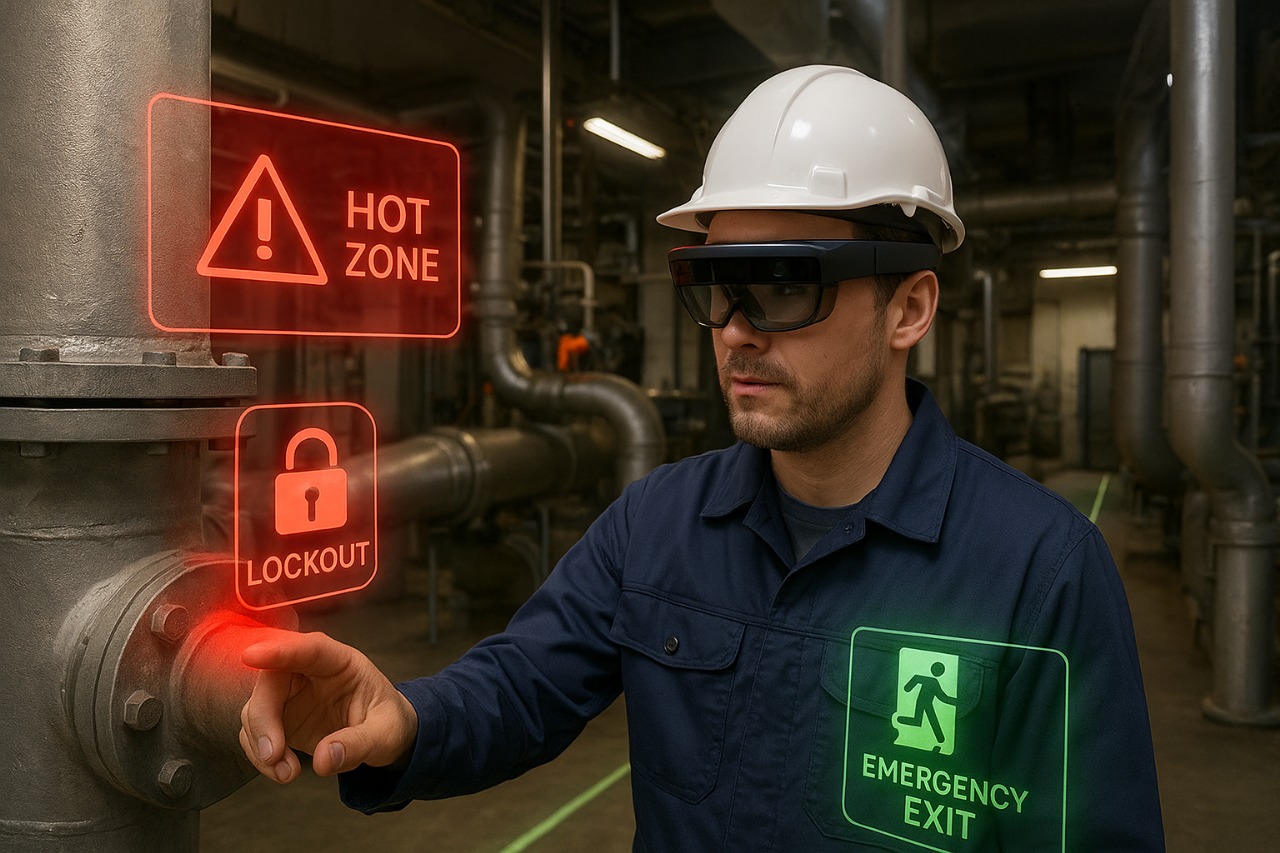
Augmented Reality (AR) is no longer confined to novelty. Facility teams are increasingly using AR to visualize infrastructure data, overlay diagnostics, and execute maintenance without constantly juggling tablets, manuals or blueprints. This shift is transforming how building systems are maintained, speeding up service, and reducing human error in complex environments.
Real-Time Diagnostics Through AR Overlays
Technicians wearing AR glasses or headsets can instantly see live system information – temperature, pressure, sensor readings, fault codes – projected onto the physical equipment in front of them. This contextual overlay helps in making faster, more informed decisions. As noted in a review of extended reality for building maintenance, AR can present information in a context-aware and more comprehensible manner … enabling more effective operations.
Guided Workflows and Reduced Cognitive Load
Switching between printed manuals, digital screens, and physical equipment is a major source of inefficiency and error. AR solves this by providing step-by-step procedural overlays. In studies of AR-assisted industrial tasks, users showed reduced task time and fewer errors.
Adaptive AR frameworks also deliver safety and task-flow benefits: one MDPI study found that AR maintenance systems significantly reduced task execution time and cognitive load, along with error rates.
Remote Expert Support via AR + Digital Twin
AR enables remote experts to join field technicians virtually — seeing exactly what the technician sees, annotating in 3D space, and guiding actions in real time. In one MDPI case study, AR was integrated into a digital twin platform to enable remote maintenance of industrial machinery: an expert at headquarters could guide on-site staff through a live AR session.
Asset Management & Building Twin Integration
AR can act as a front-end interface for digital twins of building systems. By overlaying simulation data (e.g., thermal, fluid dynamics) directly onto physical assets, facility operators can inspect past performance, identify inefficiencies, and anticipate maintenance needs. According to MDPI research, integrating AR with simulation results reduces spatial misinterpretation and supports more accurate decision-making.
Safety Assurance and Compliance
AR not only guides maintenance but also improves safety. Technicians can view hazard overlays (hot surfaces, lockout points, emergency evacuation paths) in real time through AR. According to AR-in-maintenance research, this kind of real-time cognitive augmentation helps reduce human error and supports safer interventions.


