
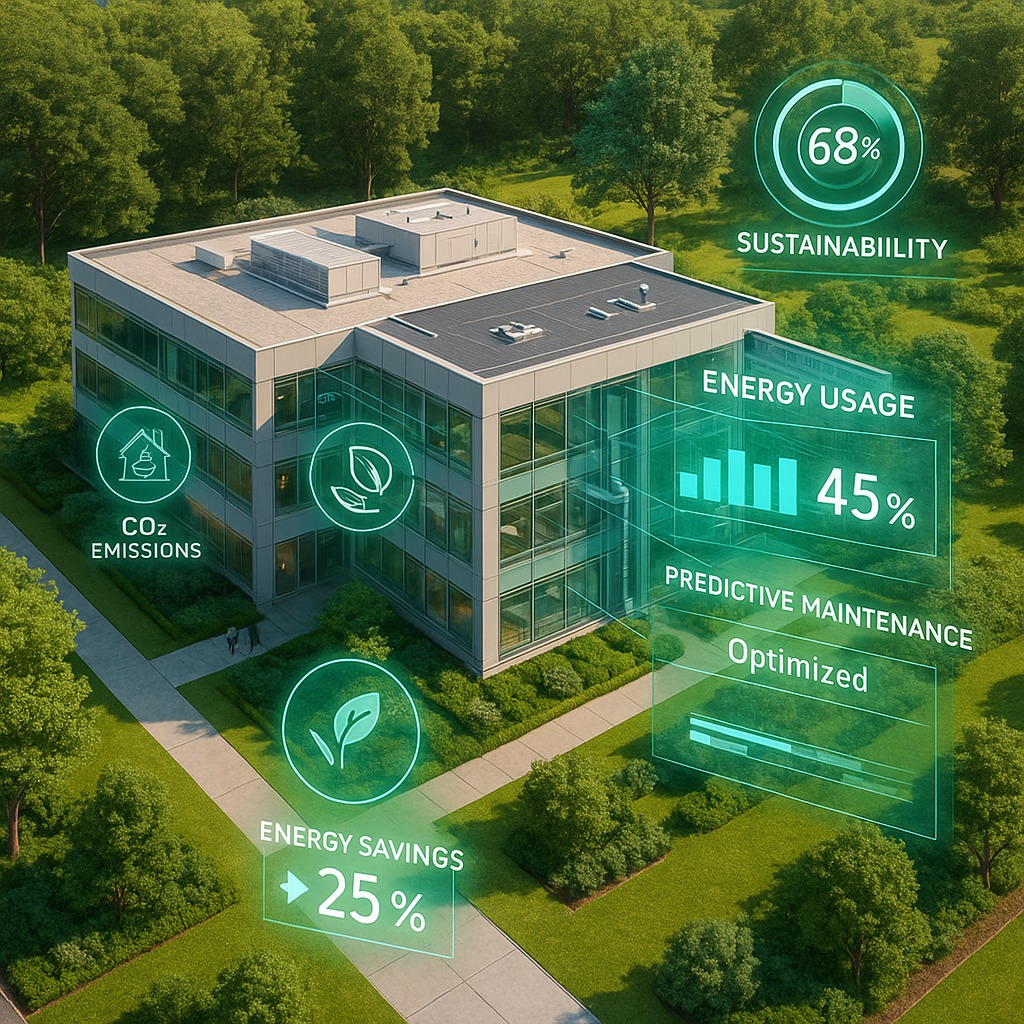
As enterprises push toward smarter and more autonomous infrastructure, predictive maintenance is breaking beyond the bounds of IT and entering the physical fabric of corporate facilities. Machine learning (ML) and IoT-based analytics are revolutionizing how companies anticipate failures in elevators, HVAC systems, and production machinery—enhancing reliability while cutting costs.
Predictive Maintenance Moves Beyond Digital Infrastructure
Predictive maintenance is no longer confined to server uptime and network reliability. Facilities now rely on AI-driven systems that use sensor data to identify performance anomalies in elevators, chillers, and compressors, enabling early intervention before breakdowns occur.
Bouabdallaoui et al. (2021) demonstrated that IoT and ML algorithms can forecast mechanical issues in real estate and building systems by continuously analyzing vibration and temperature patterns, achieving significant downtime reduction.
This predictive layer transforms facility management from reactive repair into proactive asset optimization—crucial in large, multi-campus enterprises.
Machine Learning at the Core of Smart Facilities
Modern buildings are becoming self-learning ecosystems, thanks to AI and ML integration. Research by Shaban et al. (2024) highlights that predictive maintenance for HVAC systems can reduce unplanned outages by 30–40% and improve system efficiency through AI-based fault detection and energy optimization .
These models continuously retrain with real-time data, improving diagnostic accuracy over time. The result is a cyber-physical infrastructure that adapts dynamically to usage conditions—boosting both operational efficiency and sustainability.
IoT Synergy: Connecting Physical Assets to Digital Intelligence
The synergy between AI and IoT underpins predictive maintenance success. Sensors embedded across elevators, chillers, and HVAC networks transmit operational metrics into centralized platforms for AI analysis.
Mazzetto (2025) proposed a hybrid predictive maintenance framework integrating IoT and ML, noting that such models outperform traditional schedules by detecting hidden degradation patterns in mechanical components.
This data-driven convergence allows real-time condition monitoring, automated alerts, and remote troubleshooting—creating a connected, responsive, and resilient infrastructure ecosystem.
Financial and Sustainability Impact
Predictive maintenance doesn’t just enhance uptime—it also drives sustainability. By identifying inefficiencies early, enterprises reduce energy waste and material fatigue, extending equipment lifespans and minimizing carbon emissions.
Poyyamozhi et al. (2024) emphasized that IoT-enabled maintenance in smart buildings reduces energy consumption by up to 30%, aligning with ESG and carbon-neutral strategies.
These benefits make AI-driven maintenance both an economic and environmental imperative for forward-thinking corporations.
The Future: From Prediction to Autonomous Action
The next evolution of predictive maintenance is autonomous operations—systems that not only predict failures but also execute maintenance actions automatically.
Khattach et al. (2024) introduced an end-to-end IoT architecture for real-time analytics and predictive maintenance, capable of triggering automated responses and optimizing performance autonomously.
As these technologies mature, facility management will shift toward closed-loop control systems that think, learn, and act—minimizing human intervention while maximizing operational uptime.
References
- Bouabdallaoui, Y., et al. Predictive Maintenance in Building Facilities: A Machine Learning Approach. Sensors, 2021, 21(4), 1044.
https://www.mdpi.com/1424-8220/21/4/1044 - Shaban, M., et al. Maintenance 4.0 for HVAC Systems: Addressing Fault Detection & AI Analytics. Electronics, 2024, 8(2), 66.
https://www.mdpi.com/2624-6511/8/2/66 - Mazzetto, A. Hybrid Predictive Maintenance for Building Systems. Buildings, 2025, 15(4), 630.
https://www.mdpi.com/2075-5309/15/4/630 - Poyyamozhi, A., et al. IoT—A Promising Solution to Energy Management in Smart Buildings. Buildings, 2024, 14(11), 3446.
https://www.mdpi.com/2075-5309/14/11/3446 - Khattach, A., et al. End-to-End Architecture for Real-Time IoT Analytics and Predictive Maintenance. PMC, 2024.
https://pmc.ncbi.nlm.nih.gov/articles/PMC12074242/


